


Page 17 - Demo
P. 17
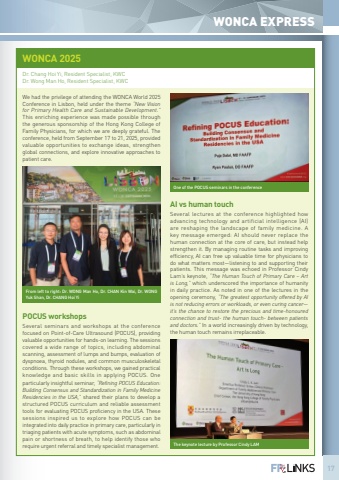
17WONCA EXPRESSWe had the privilege of attending the WONCA World 2025 Conference in Lisbon, held under the theme %u201cNew Vision for Primary Health Care and Sustainable Development.%u201d This enriching experience was made possible through the generous sponsorship of the Hong Kong College of Family Physicians, for which we are deeply grateful. The conference, held from September 17 to 21, 2025, provided valuable opportunities to exchange ideas, strengthen global connections, and explore innovative approaches to patient care.Dr. Chang Hoi Yi, Resident Specialist, KWCDr. Wong Man Ho, Resident Specialist, KWCWONCA 2025AI vs human touchSeveral lectures at the conference highlighted how advancing technology and artificial intelligence (AI) are reshaping the landscape of family medicine. A key message emerged: AI should never replace the human connection at the core of care, but instead help strengthen it. By managing routine tasks and improving efficiency, AI can free up valuable time for physicians to do what matters most%u2014listening to and supporting their patients. This message was echoed in Professor Cindy Lam%u2019s keynote, %u201cThe Human Touch of Primary Care %u2013 Art is Long,%u201d which underscored the importance of humanity in daily practice. As noted in one of the lectures in the opening ceremony, %u201cThe greatest opportunity offered by AI is not reducing errors or workloads, or even curing cancer%u2014it%u2019s the chance to restore the precious and time-honoured connection and trust- the human touch- between patients and doctors.%u201d In a world increasingly driven by technology, the human touch remains irreplaceable.POCUS workshops Several seminars and workshops at the conference focused on Point-of-Care Ultrasound (POCUS), providing valuable opportunities for hands-on learning. The sessions covered a wide range of topics, including abdominal scanning, assessment of lumps and bumps, evaluation of dyspnoea, thyroid nodules, and common musculoskeletal conditions. Through these workshops, we gained practical knowledge and basic skills in applying POCUS. One particularly insightful seminar, %u201cRefining POCUS Education: Building Consensus and Standardization in Family Medicine Residencies in the USA,%u201d shared their plans to develop a structured POCUS curriculum and reliable assessment tools for evaluating POCUS proficiency in the USA. These sessions inspired us to explore how POCUS can be integrated into daily practice in primary care, particularly in triaging patients with acute symptoms, such as abdominal pain or shortness of breath, to help identify those who require urgent referral and timely specialist management.One of the POCUS seminars in the conferenceFrom left to right: Dr. WONG Man Ho, Dr. CHAN Kin Wai, Dr. WONG Yuk Shan, Dr. CHANG Hoi YiThe keynote lecture by Professor Cindy LAM


