


Page 10 - Demo
P. 10
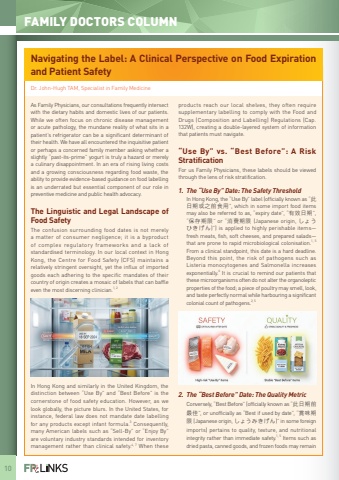
10FAMILY DOCTORS COLUMNDr. John-Hugh TAM, Specialist in Family MedicineAs Family Physicians, our consultations frequently intersect with the dietary habits and domestic lives of our patients. While we often focus on chronic disease management or acute pathology, the mundane reality of what sits in a patient%u2019s refrigerator can be a significant determinant of their health. We have all encountered the inquisitive patient or perhaps a concerned family member asking whether a slightly %u201cpast-its-prime%u201d yogurt is truly a hazard or merely a culinary disappointment. In an era of rising living costs and a growing consciousness regarding food waste, the ability to provide evidence-based guidance on food labelling is an underrated but essential component of our role in preventive medicine and public health advocacy.The Linguistic and Legal Landscape of Food SafetyThe confusion surrounding food dates is not merely a matter of consumer negligence; it is a byproduct of complex regulatory frameworks and a lack of standardised terminology. In our local context in Hong Kong, the Centre for Food Safety (CFS) maintains a relatively stringent oversight, yet the influx of imported goods each adhering to the specific mandates of their country of origin creates a mosaic of labels that can baffle even the most discerning clinician.1, 2In Hong Kong and similarly in the United Kingdom, the distinction between %u201cUse By%u201d and %u201cBest Before%u201d is the cornerstone of food safety education. However, as we look globally, the picture blurs. In the United States, for instance, federal law does not mandate date labelling for any products except infant formula.3 Consequently, many American labels such as %u201cSell-By%u201d or %u201cEnjoy By%u201d are voluntary industry standards intended for inventory management rather than clinical safety.4, 7 When these Navigating the Label: A Clinical Perspective on Food Expiration and Patient Safetyproducts reach our local shelves, they often require supplementary labelling to comply with the Food and Drugs (Composition and Labelling) Regulations (Cap. 132W), creating a double-layered system of information that patients must navigate.%u201cUse By%u201d vs. %u201cBest Before%u201d: A Risk StratificationFor us Family Physicians, these labels should be viewed through the lens of risk stratification.1. The %u201cUse By%u201d Date: The Safety ThresholdIn Hong Kong, the %u201cUse By%u201d label (officially known as %u201c%u6b64%u65e5%u671f%u6216%u4e4b%u524d%u98df%u7528%u201d, which in some import food items may also be referred to as, %u201cexpiry date%u201d, %u201c%u6709%u6548%u65e5%u671f%u201d, %u201c%u4fdd%u5b58%u671f%u9650%u201d or %u201c%u6d88%u8cbb%u671f%u9650 (Japanese origin, %u3057%u3087%u3046%u3072%u304d%u3052%u3093)%u201d) is applied to highly perishable items%u2014fresh meats, fish, soft cheeses, and prepared salads%u2014that are prone to rapid microbiological colonisation.1, 5From a clinical standpoint, this date is a hard deadline. Beyond this point, the risk of pathogens such as Listeria monocytogenes and Salmonella increases exponentially.6 It is crucial to remind our patients that these microorganisms often do not alter the organoleptic properties of the food; a piece of poultry may smell, look, and taste perfectly normal while harbouring a significant colonial count of pathogens.2, 52. The %u201cBest Before%u201d Date: The Quality MetricConversely, %u201cBest Before%u201d (officially known as %u201c%u6b64%u65e5%u671f%u524d%u6700%u4f73%u201d, or unofficially as %u201cBest if used by date%u201d, %u201c%u8cde%u5473%u671f%u9650 (Japanese origin, %u3057%u3087%u3046%u307f%u304d%u3052%u3093)%u201d in some foreign imports) pertains to quality, texture, and nutritional integrity rather than immediate safety.1, 5 Items such as dried pasta, canned goods, and frozen foods may remain


